
The Impact-Obsessed Guide to Better PR Reporting
End-of-year reporting is one of our favorite times of the year. But while many agencies focus on taking a victory lap, at Dadascope, we’re crunching the numbers, so we can surface the business impacts, insights and trends that drive our clients’ businesses.
This guide explains what modern PR reporting should include, how to tie PR results to business outcomes, and what brand leaders should expect from their PR partner, including how to measure credibility, performance, and AI discoverability.
Sure, we still include pretty screenshots and reach numbers in our reports (some metrics die hard), but we also give our clients the quantitative and qualitative firepower they need to defend budgets, gain executive buy-in, and stay on top of the trends that are driving growth, especially now, as discovery shifts toward AI.
What good PR reporting actually does
Good PR reporting does three things:
Connects directly to business outcomes (revenue, competitive positioning, reputation, and AI visibility)
Tells a story, backed by measurable data so leadership understands why results matter
Informs future strategy, not just past performance
Prove Value
〰️
Earn Trust
〰️
Plan Smarter
〰️
Prove Value 〰️ Earn Trust 〰️ Plan Smarter 〰️
This guide was created to raise the bar on PR reporting and help brands maximize the return on their PR spend, but we also acknowledge that this level of reporting is an investment. It takes time, experience, and the right tools that not every brand has the budget to invest in. That said, strong reporting is often what protects your PR investment in the first place. It helps you prove what’s working, spot what’s not, and realign before you spend another six months on the wrong strategy.
“Even as a small agency, we invest heavily in reporting infrastructure and senior-level analysis, primarily because we believe so passionately in what we do and the opportunities we create for our clients.”
And as PR takes the lead on AEO, these reports become assets that can provide value at every level of the organization, informing content, partnerships, paid media, executive communications, retail strategy, product innovation and more.
PR’s value often lives in the space between standard datapoints, which is why we rely on industry-leading, PR-specific technology solutions that reveal our meaningful contributions. In fact, we just made one of those big investments: we are proud to be among the first agencies to offer our clients AI visibility monitoring and benchmarking via Meltwater’s GenAI Lens platform.
Strategic reporting is one of PR’s strongest opportunities to show its value as an essential business partner, and, in turn, make clients look like rockstars in the next board meeting.
Not sure what you should expect next time your agency hands over a report? We put together this guide to ensure you’re getting the most in your reports, whether you’re working with us, or another partner.
What does good PR reporting look like?
Good PR reporting connects earned media to business outcomes, not just coverage metrics.
A Six-Step Guide
1) Business Alignment…and Realignment
What should a PR partner do to align reporting with business goals?
Good reporting starts at onboarding because you can’t understand what to measure until you learn what matters to the business. Skipping this step is one of the main reasons reporting can miss the mark.
What you should expect
A clear definition of success that dives into PR’s “why” and reflects what leadership is working toward:
revenue and growth
competitive leadership
credibility and trust
reputation protection
partnerships, retail, investor interest
AI visibility
Red Flag
If your report doesn’t tie PR metrics to business outcomes, key stakeholders will tune out.
The Fix
PR teams and clients are responsible for asking questions and listening closely to make sure PR activities and KPI’s map back to larger, higher-level business goals and leadership priorities.
We also recommend quarterly check-ins to ensure that the goals established at the beginning of an engagement remain aligned with business priorities. Then, update strategies, tactics and KPI’s accordingly.
2. Benchmarking
Why should PR benchmark results?
Benchmarking is how you establish your starting point, so change can be measured accurately over time and against milestones.
Without benchmarking, you can’t prove growth, just like you can’t tell a story without a beginning.
What you should expect
A baseline established early and reported against regularly.
Benchmarks that demonstrate data in context.
Red Flag
If your agency can’t show baseline → movement → lift, you’re flying blind.
The Fix
Always ask your agency, “What are we benchmarking, and how will you show change quarter over quarter?”
3. Choose Your Metrics Wisely (and Don’t Be Afraid to Revisit and Revise)
Which KPI’s should we track?
The most meaningful PR metrics reflect credibility, relevance, and action — not just volume.
Reach isn’t impact, and you can’t take impressions to the board. Ensure the KPI’s your agency is monitoring reflect what drives your individual business.
What you should expect
Systems and defined metrics for tracking:
Tracking coverage quality, not just quantity e.g., tiering, prominence score
Coverage impact e.g., referral traffic, consumer survey responses, PR-driven revenue, AI visibility score
Reputation + trust indicators e.g., sentiment trends, executive quotes
Red Flag
If reach is still the headline, reporting is built for optics vs. outcomes.
The Fix
Take the time to determine the KPI’s that map back to your business, then make sure that data is being shared across functions to tell the most complete and integrated story.
When business goals or focus change, be sure to update your PR team, so that they can evolve their approach and KPI’s accordingly.
4. Reporting That Reads Like Strategy
How can PR reporting be more strategic?
A strategic PR report uses narrative and data to tell leadership why results matter.
A great report should feel like a business document, not a scrapbook.
What you should expect
A strong PR report should tell a clear story, grounded in data, with learnings and recommendations baked in.
A consistent narrative arc:
Goals
〰️
Strategy
〰️
Results
〰️
Impact
〰️
Learnings
〰️
Next Steps
Goals 〰️ Strategy 〰️ Results 〰️ Impact 〰️ Learnings 〰️ Next Steps
Learnings that reveal transparency: What did and didn’t work and why, and how we’re correcting course.
Recommendations leadership can act on:
priorities for next quarter
messaging and positioning adjustments
channel and outreach shifts
cross-functional needs (e-commerce needs, inventory, partnerships, paid media)
Red Flag
If your report reads more like record-keeping than strategy.
The Fix
Ask your PR partner, “What have we learned about what worked, what didn’t, and how we can improve?”
5. The Visibility Engine
“What happened after the story ran?”
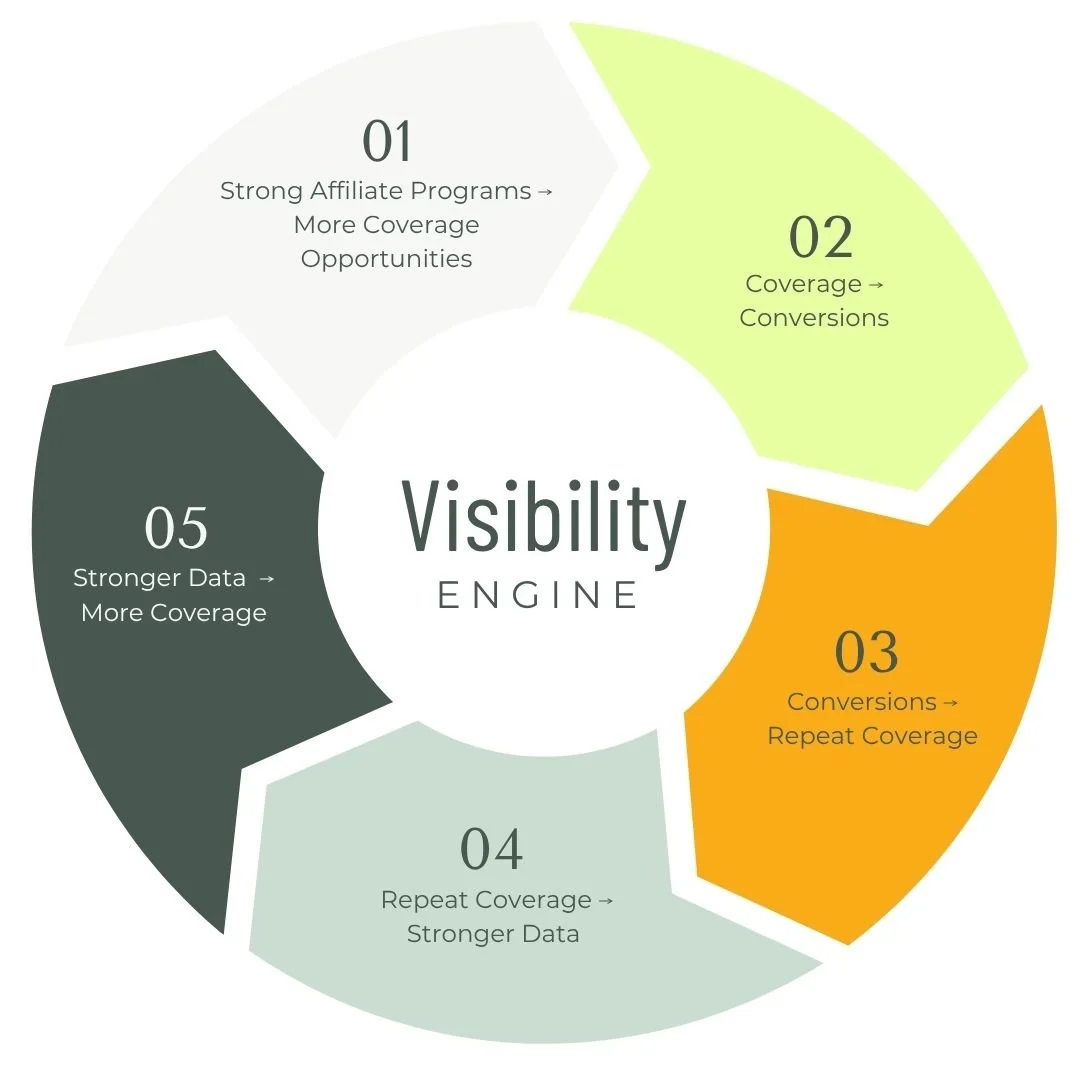
How can PR connect performance data?
PR creates a Visibility Engine that drives Discoverability >> Trust >> Conversion.
What you should expect
Affiliate and commerce data and insights
Cross-functional integration
Red Flag
If PR and performance are treated as separate worlds, you’re losing compounding benefits.
The Fix
Ensure your PR team has the affiliate marketing know-how to connect PR to performance.
Despite the unfortunate tendency to put PR in a Silo, it really works best when collaborating across the marketing organization, so be sure your PR, affiliate, e-comm, paid, content and influencer teams are sharing insights and assets.
“There’s an unfortunate tendency to put PR in a silo, but that really diminishes returns. We encourage our clients to foster bridges between PR, affiliate, e-comm, paid, content and influencer teams in order to see the greatest impact.”
6. AI-Powered Data and Insights
How should PR be using AI?
AI discoverability is a new frontier for PR, requiring benchmarks and monitoring to remain visible in emerging search landscapes.
This is the next major shift it’s happening FAST. Your reporting — and your planning — should reflect it now.
Consumer discovery is changing. LLMs like ChatGPT, Perplexity, and Google AI Overviews increasingly prioritize credible sources, and earned content has become the leading input training LLM’s on how to surface brands. Thanks to new tools, PR can quantify its outsized impact while gleaning key insights that drive growth and efficiency into the future.
What you should expect:
AI visibility benchmarks and monitoring that reveals:
how often your brand appears in AI-generated answers
share of voice vs competitors in AI summaries
accuracy and prominence of brand and messaging
AI-powered insights to improve PR outcomes and planning:
top AI sources
align pitches with leading prompts
ID experts for partnership
Red Flag
Your PR partner isn’t exploring — or, even better, investing in — AI visibility and intelligence solutions.
The Fix
Ask your PR partner: “How are you tracking our visibility in AI discovery systems — and how will we grow it?”
Red Flag
Your PR partner isn’t exploring — or, even better, investing in — AI visibility and intelligence solutions.
The Fix
Ask your PR partner: “How are you tracking our visibility in AI discovery systems — and how will we grow it?”
Want to pressure-test your current PR reporting?
Raising the bar on reporting raises the value of PR, and that’s good for the industry we love. That’s why we offer a Reporting Audit that evaluates your current reports against this checklist and shares recommendations to strengthen measurement, narrative, and AI visibility tracking.
Drop us a line to learn more. And happy reporting season!
“We’re proud to be among the first agencies to offer AI visibility monitoring and benchmarking via Meltwater’s GenAI Lens platform.”
PR Reporting FAQ: What Brand Leaders Should Know
What is impact-obsessed PR reporting?
Impact-obsessed PR reporting focuses on business outcomes rather than vanity metrics. It connects earned media to indicators like revenue influence, competitive share of voice, credibility, reputation, and AI discoverability. Instead of summarizing activity, it explains what changed because of PR and why it matters to the business.
What should a PR report include in 2025 and beyond?
A modern PR report should include:
Clear alignment to business goals
Benchmarked starting points
Metrics that reflect credibility, relevance, and action
Strategic insights and learnings
Recommendations for what to do next
Visibility in AI-driven discovery platforms
If a report doesn’t help leadership make decisions, it’s incomplete.
Why aren’t reach and impressions enough to measure PR?
Reach and impressions measure potential exposure, not impact. They don’t show whether the right audience engaged, trusted the message, or took action. Brand leaders need metrics that demonstrate relevance, authority, and business lift — not just scale.
What metrics actually matter in PR reporting?
The most meaningful PR metrics fall into four categories:
Credibility: outlet quality, Domain Authority, expert or founder quotes, sentiment
Relevance: audience alignment, message pull-through, purchase intent signals
Action: referral traffic, clicks, affiliate conversions, funnel movement
AI Visibility: how often a brand appears in AI-generated answers relative to competitors
Together, these show how PR influences both perception and performance.
What is benchmarking in PR reporting, and why does it matter?
Benchmarking establishes a baseline before results are reported. It shows where a brand started so progress can be measured honestly over time. Without benchmarks, PR reporting can only show activity — not growth or transformation.
How often should PR benchmarks be updated?
Benchmarks should be reviewed at the start of a program and revisited quarterly or annually, depending on the scope of work. As business goals, competitors, and media landscapes change, benchmarks need to evolve with them.
How should PR reporting tell a story?
Strong PR reporting follows a narrative arc:
Goal → Strategy → Results → Impact → Learnings → Recommendations
This structure helps leadership understand not just what happened, but why it mattered and how insights should inform future decisions.
Why are learnings important in PR reporting?
Learnings show strategic maturity. They demonstrate that your PR partner is paying attention, identifying friction, and adapting intentionally. Honest evaluation builds trust and improves results over time.
How does PR connect to performance and revenue?
PR builds credibility, which drives consideration and conversion. When paired with affiliate or performance data, PR reporting can show how coverage drives clicks, sales, and long-term value. This connection helps leadership understand PR’s role across the full funnel.
What is AI discoverability in PR?
AI discoverability refers to how often and how accurately a brand appears in AI-generated answers from platforms like ChatGPT, Perplexity, and Google AI Overviews. These systems prioritize credible, earned editorial sources — making PR a key input into AI-driven discovery.
How can brands measure AI discoverability from PR?
Brands can benchmark AI visibility using tools like Meltwater’s GenAI Lens, which tracks how often a brand surfaces in AI-generated results, which sources are cited, and how messaging is represented. These insights can then inform PR strategy and outreach.
Is advanced PR reporting expensive?
Impact-focused PR reporting is an investment. It requires senior expertise, time, and the right tools — and not every brand needs deep analysis every quarter. However, strong reporting often pays for itself by proving what’s working or revealing where strategy should change before more budget is spent.
How does strong PR reporting benefit teams beyond PR?
High-quality PR reporting can inform:
Content and messaging strategy
Paid media and e-commerce optimization
Partnership and retail outreach
Investor and stakeholder communications
Brand positioning and product strategy
The insights often extend far beyond the PR function.